
A question that is often asked in Drupal circles, is how much can a Drupal site scale to, and what is the hardware necessary to make it do that. The answers often go on tangents, with some advocating multiple web boxes, with a reverse proxy in front of them, and multiple master/slave MySQL boxes too, like we have on Drupal.org.
The real answer is : it depends ...
Depends on what? Many things, like:
- How many and what modules do you have on the site?
- Is your traffic mainly anonymous or logged in users?
- The hardware you have.
- The software configuration you have.
While there is no canned answer, there are plenty of things you can do to increase performance.
Here is a case study of a site that can handle a million page views a day, including a Digg front page.
Normal traffic pattern
This is the normal traffic patter for this site. The weekends are low traffic, but weekdays are busy. Monday is the busiest day of the week, where people login from work to catch up on the content that was posted over the weekend.
On a busy day, the site does close to 880,000 page views per day.
The site does around 17 to 18 million page views a month.
Much of the traffic on this site is by logged in users,
checking new content, commenting on it, and creating their own node.
Day ---Date----  Visits  Page Views  ---Hits--   Bandwidth
Mon 25 Feb 2008  53,636  879,777     7,636,793   90.69 GB
Tue 26 Feb 2008  53,636  876,492     7,446,068   85.82 GB
Wed 27 Feb 2008  52,552  818,191     7,034,696   80.03 GB
...
Sat 01 Mar 2008	 29,999  324,972     2,781,091   33.05 GB
Sun 02 Mar 2008	 33,709  431,533     3,518,855   42.37 GB
...
Mon 03 Mar 2008  49,683  865,697     7,429,576   85.27 GB
Tue 04 Mar 2008  50,981  831,947     6,990,756   80.63 GB
Wed 05 Mar 2008  51,907  831,332     7,162,797   81.47 GB
On Digg's front page
When this site recently got on Digg's front page, it was on a Sunday, but the long tail was well into Monday. This caused Monday's traffic to be 985,000 page views, with double the normal visits.
If the site was on Digg on a weekday, the 1 million page per view mark would have been broken easily.
Since Digg's traffic is all anonymous, caching protects well against that.
Day ---Date----  Visits  Page Views  ---Hits--   Bandwidth
Sun 09 Mar 2008  98,984  505,852     5,978,013   80.99 GB
Mon 10 Mar 2008 111,201  985,229    10,215,878  127.62 GB
Tue 11 Mar 2008  58,146  818,198     7,442,787   86.90 GB
Wed 12 Mar 2008  55,531  807,695     7,099,067   79.75 GB
Server Configuration
The site is on a single server, with all the LAMP stack running on it. It has dual Quad core Xeons (8 cores total), and 8GB or memory with 64bit Linux (Ubuntu server).
There is no reverse proxy.
There is no InnoDB.
There are no multiple boxes.
The video content from the site is served from another box, but all the images are still on the same box.
We use memcache without the database caching.
We use a few custom performance patches (alias whitelist, last access time is written every 5 minutes only not every page view).
More importantly, the site has only 46 modules, as opposed to the 80-120 we find on sites these days.
Server Resource Utilization
During the Digg, it was interesting to see resource utilization. Here are some graphs to illustrate.
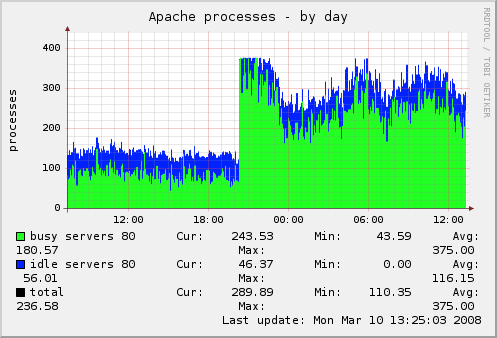
This is the Apache number of processes. You can see how it jumped up to reach the MaxClients limit of 375 briefly. This is a safety mechanism to avoid swapping which can kill the server, at the expense of queuing some users.
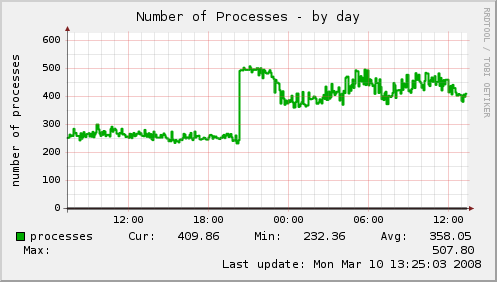
This is the total number of processes in the server, mainly Apache processes.
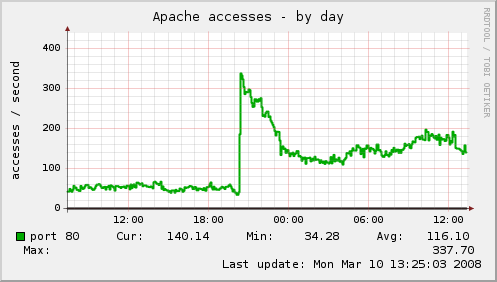
This is the number of access (i.e. hits not pages!) per second that Apache is serving.This is around 340 per second, as opposed to the normal of 150 per second.
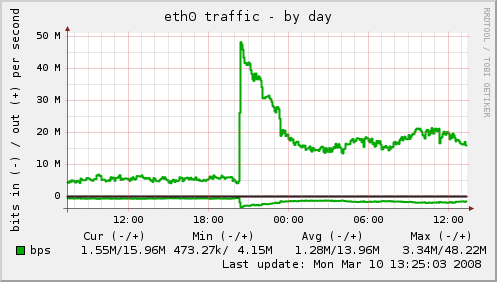
This is the number of bits going in and out of the internet ethernet facing port (eth0).
Update April 10, 2008:
It's official: the site broke the 1,000,000 page view per day mark without being on Digg.
07 Apr 2008	59294	960453	8240531	95.76 GB
08 Apr 2008	58803	1007068	8384384	104.53 GB
09 Apr 2008	60346	987919	7856087	95.30 GB
Update July, 2010:
After almost 2.5 years, we at 2bits.com have dealt with even larger sites.
Please check our presentation on a site that does 2.8 million page views per day, 70 million per month, one server!.
That site broke the record later, and did 3.4 million page views in one day, and 92 million in one month.


Comments
Visitor (not verified)
"This is the Apache number
Thu, 2008/03/13 - 18:38"This is the Apache number of processes. You can see how it jumped up to reach the MaxClients limit of 375 briefly."
At last week's Drupalcon in Boston, Brain Aker (MySQL's chief architect) recommended to not set the MaxClients limit too high. A limit that is too high, will cause Apache to overload, he said. Have you ever experienced this problem? How did you determine to set the MaxClients limit to 375?
Khalid
Relative ...
Thu, 2008/03/13 - 23:02"High" and "low" are relative.
Having the MaxClients too high will cause thrashing under load. This is when the server runs out of memory because it is trying to spawn more processes than what would fit in memory. Many Linux distros come with that parameter as 512, which is way to high.
This value acts as a safety mechanism, to prevent thrashing, but you want enough processes to handle the load too, so it is a balance.
There are two ways to determine the optimal value:
1. Calculation:
Find out how many Apache processes (plus whatever else is running) will fit in your memory, and put that in.
2. Trial and Error:
Monitor the server for how many processes are being used, and see if you plateau somewhere and increase slowly.
I advocate a mixed approach, where you start with 1, then adjust using 2 incrementally.
See more on our article tuning the Apache MaxClients parameter.
--
2bits -- Drupal and Backdrop CMS consulting
Visitor (not verified)
Very useful, thanks!
Fri, 2008/03/14 - 14:02Very useful, thanks!
Visitor (not verified)
Did you do any optimization
Thu, 2008/03/13 - 19:12Did you do any optimization on this Drupal install to get this kind of performance? Also, is this site on Drupal 5?
Thanks for sharing.
Khalid
Lots of it
Thu, 2008/03/13 - 22:42Yes, it is Drupal 5.7.
Yes, did lots of optimization, but not as much as people think is necessary. There are a few patches in there, and most of them are already in the issue queue on Drupal.org.
The key here is not to go on a module binge. I believe that is the most important aspect.
You can read more on Drupal performance tuning and optimization for large web sites.
--
2bits -- Drupal and Backdrop CMS consulting
Visitor (not verified)
monitoring
Fri, 2008/03/14 - 15:19Hi, thank you so much for sharing this.
What software do you use to monitor your server performance? What software did you use to produce these graphs?
Alex
Khalid
Munin
Fri, 2008/03/14 - 15:27It is Munin. See more on our article on tools for performance tuning and optimization.
--
2bits -- Drupal and Backdrop CMS consulting
Visitor (not verified)
over 1 million hits
Wed, 2008/06/11 - 17:16popsci.com has done over 1.2 millions hits in one day. req per second peaked about 1210.
Khalid
Hits vs. Page views
Wed, 2008/06/11 - 17:19Hits is not the same as page views.
Each page views incurs multiple hits. So a site with 1.2 million hits per day would perhaps have several hundred thousand page views a day only.
--
2bits -- Drupal and Backdrop CMS consulting
Visitor (not verified)
Thanks for clearing up the
Mon, 2008/06/30 - 15:22Thanks for clearing up the difference between hits and visits. I'm still trying to get my head around all this stuff and it's certainly been a steep learning curve. However I think I'm getting to grips with it eventually.
Pages